

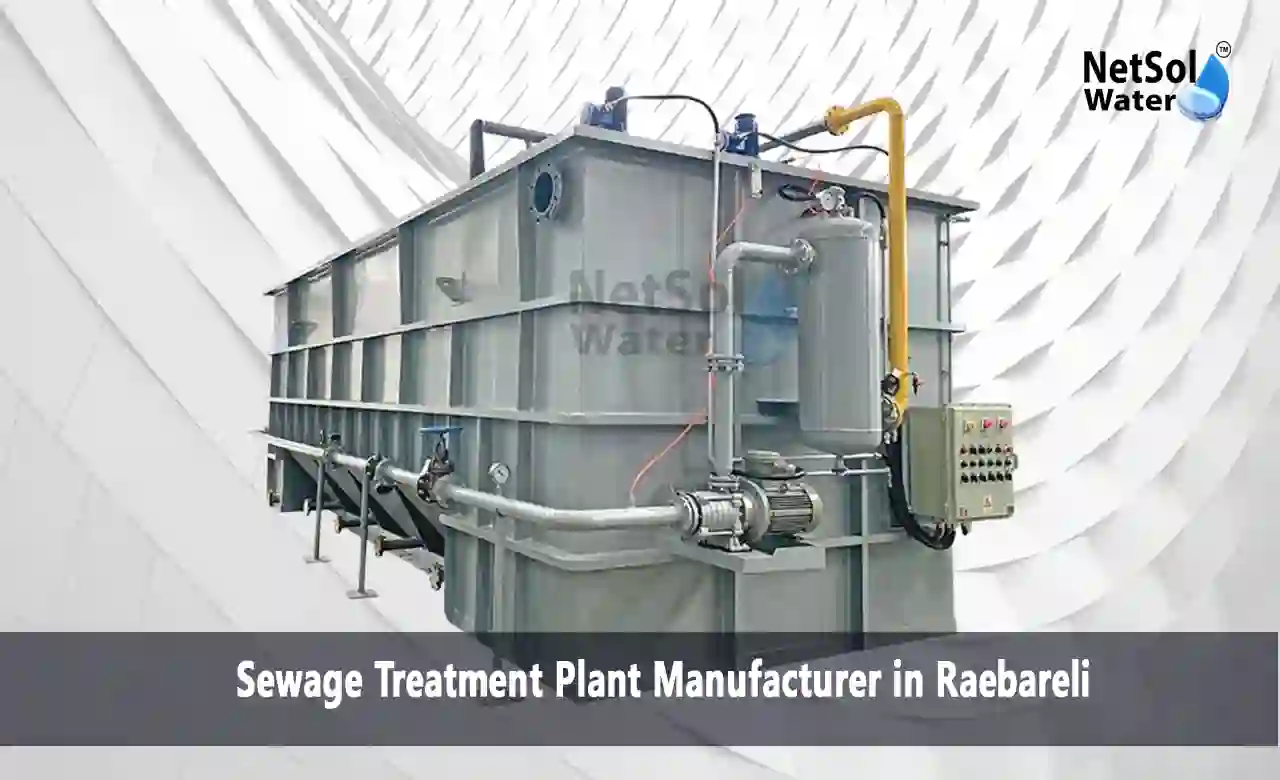
Sewage Treatment Plant Manufacturer in Raebareli
A sewage treatment plant (STP) treats domestic and commercial wastewater through preliminary, biological, secondary clarification, and disinfection stages - making it safe for reuse or discharge. NetSol Water is a trusted STP manufacturer in Raebareli serving residential complexes, hospitals, hotels and industrial units across Uttar Pradesh.
Is Your Property Generating Wastewater with No Safe Exit?
Raebareli is growing fast. New housing societies are coming up, industries are expanding, and commercial spaces are multiplying every year. That's great news for the economy - but there's a challenge most developers and facility managers don't think about until it's too late: wastewater.
Every building generates sewage - daily, constantly, without pause. Kitchens, bathrooms, laundry, labs, and food units all contribute. If that water isn't treated properly, it doesn't vanish. It seeps into groundwater, contaminates soil, and reaches nearby water bodies.
That's exactly why choosing the right Sewage Treatment Plant Manufacturer in Raebareli matters - not just for regulatory compliance, but for long-term environmental and financial responsibility.
Why an STP Is One of the Smartest Investments You Can Make
A lot of facility owners see an STP as an added expense. But once you look at the numbers over time, it's clearly the opposite.
Here's what a properly designed STP gives you:
. Treated water reusable for flushing, gardening, and cooling - saving significantly on water bills
. Protection against CPCB and UP Pollution Control Board fines and legal notices
. Higher property credibility and better compliance scores for certifications
. Reduced dependence on costly water tankers or fresh water sources
. Contribution to sustainable water management in a water-stressed region
For context: a residential society of 200 flats in Raebareli generates roughly 60,000 to 80,000 litres of wastewater every day. With an STP, a significant portion of that can be recycled. Without one, it either goes into a failing soak pit or causes health hazards.
What Does Sewage Actually Contain?
Most people assume sewage is just dirty water. It's far more complex - and that's why simple filtration never works.
Typical municipal and domestic sewage contains:
. Organic matter (food particles, human waste, oils)
. Suspended solids and fine debris
. Harmful bacteria, pathogens, and viruses
. Chemicals from cleaning agents and detergents
. In industrial areas: heavy metals, solvents, and process chemicals
Each of these contaminants requires a specific treatment stage. That's why a well-designed STP isn't one machine - it's a complete, multi-stage system.
How a Sewage Treatment Plant Works?
Understanding the treatment process helps you evaluate whether a manufacturer's design is genuinely suited to your site or just a generic off-the-shelf solution.
1: Preliminary Treatment
Large solids - plastic waste, rags, grit, sand - are screened and removed before they damage downstream equipment. This step protects the system and extends the lifespan of pumps and pipes. Skipping or undersizing this stage causes frequent mechanical failures.
2: Biological Treatment (Core Stage)
Here, specially cultivated microorganisms break down the dissolved organic matter in sewage. Technologies like MBBR (Moving Bed Biofilm Reactor), SBR (Sequential Batch Reactor), and Extended Aeration all function at this stage - but each has different efficiency levels, footprints, and costs. Choosing the right one for your wastewater load is critical.
3: Secondary Clarification
After biological treatment, water enters a settling tank where fine suspended solids separate out as sludge. The cleaner water above moves forward for final treatment. Proper design of this stage determines how clear the output water will be.
4: Disinfection
The final stage removes pathogens using chlorination or UV disinfection systems. This is what makes treated water safe for reuse in flushing, landscaping, and cooling towers - or safe for discharge into drains compliant with CPCB norms.
STP Technologies Explained: Which One Is Right for You?
One of the most common mistakes in STP projects is selecting a technology based on cost alone. The right choice depends on your site conditions, space availability, wastewater volume, and output quality requirements.
1. MBBR - Moving Bed Biofilm Reactor
MBBR uses plastic media carriers inside aeration tanks, providing a large surface area for biological activity. It's compact, easy to operate, and handles load variations well. Best suited for residential societies and mid-size commercial buildings. A 200 KLD MBBR plant typically requires around 200-250 sq. ft. of space.
2. SBR - Sequential Batch Reactor
SBR treats wastewater in timed batches - fill, aerate, settle, discharge - giving excellent control over the process. It's ideal for sites where inflow is irregular or fluctuates through the day. Commonly used in hotels, hospitals, and educational institutions.
3. MBR - Membrane Bioreactor
MBR combines biological treatment with ultrafiltration membranes, producing high-quality output suitable for even sensitive reuse applications. It requires less space than conventional systems but costs more upfront. The long-term savings on water reuse justify the investment for many projects.
4. Extended Aeration
One of the most reliable and proven technologies, extended aeration keeps wastewater in aerated tanks for longer periods, thoroughly digesting organic matter. It requires more space but is known for stable, low-maintenance operation - popular for township-scale projects.
Which Sectors in Raebareli Need an STP?
Sewage treatment is now mandatory across most property types under UP state regulations and CPCB guidelines. Here's how demand is distributed:
. Residential Complexes: Apartment buildings and gated communities with 20+ units are required to install STPs
. Hospitals & Healthcare: Medical wastewater contains pathogens that require specialized treatment before discharge
. Hotels & Hospitality: High water consumption means large volumes of daily sewage that must be managed efficiently
. Educational Institutions: Hostels and campuses generate continuous, predictable wastewater loads
. Commercial Buildings: Malls, offices, and government buildings face strict compliance requirements
. Industrial Units: Many small manufacturers generate mixed domestic + process wastewater needing combined treatment
Typical STP Capacities and What They Cover
. 1–50 KLD: Small residential societies, standalone hospitals, smaller hotels
. 50–200 KLD: Large housing complexes, mid-size industrial campuses
. 200–500 KLD: Large townships, commercial districts, institutional campuses
. 5 KLD and above: Municipal and semi-urban level applications
What to Look for in an STP Manufacturer in Raebareli?
The market has dozens of suppliers, but not all of them deliver systems that perform in real-world conditions. Here's what genuinely matters:
. In-house manufacturing capability - not outsourced assembly
. Water testing before design, not after installation
. Clear technology recommendation with reasoning - not just the cheapest option
. CPCB-compliant output guarantee with documented performance data
. ISO certification and structured quality control processes
. Strong after-sales support including AMC and emergency service
Why NetSol Water?
NetSol Water is an ISO-certified sewage treatment plant manufacturer and supplier in Uttar Pradesh. We manufacture in-house, test before we design, and stay with our clients long after installation. Every plant we build is custom-designed - not a catalogue product.
Ready to Get Your STP Designed? Contact NetSol Water Today for a Free Site Assessment and Custom Quote.
FAQ - Sewage Treatment Plant Manufacturer in Raebareli
Q: What is a sewage treatment plant and how does it work?
A: A sewage treatment plant (STP) removes contaminants from domestic and commercial wastewater through four stages: preliminary screening, biological treatment, secondary clarification, and disinfection. The result is treated water safe for reuse in flushing, irrigation, and cooling - or for compliant discharge into drains per CPCB norms.
Q: Which sewage treatment plant technology is best for residential societies in Raebareli?
A: MBBR (Moving Bed Biofilm Reactor) is most popular for residential societies in Raebareli due to its compact footprint, ease of operation, and ability to handle varying daily loads. SBR is preferred where wastewater inflow is irregular throughout the day. An expert assessment of your site determines the best fit.
Q: What is the capacity of STP needed for a 100-flat housing society?
A: A housing society with 100 flats typically requires an STP with a capacity of 50 to 80 KLD (Kilolitres per Day), assuming 4–5 residents per flat generating roughly 135 litres per person per day. Actual sizing should be based on a proper water audit and future expansion plans.
Q: Is it mandatory to install an STP in Raebareli?
A: Yes. Under UP Pollution Control Board and CPCB guidelines, residential complexes above a defined scale, commercial buildings, hospitals, and industries are required to install STPs. Non-compliance leads to fines, legal notices, and in severe cases, facility closure. It is advisable to install before applying for building occupancy certificates.
Q: How much does a sewage treatment plant cost in Raebareli?
A: STP costs in Raebareli vary based on capacity and technology. A 50 KLD MBBR plant typically costs between Rs. 8 to 15 lakh, while larger 200–500 KLD systems range from Rs. 25 to 60 lakh. MBR-based systems cost more but offer higher output quality. Always get a site-specific quote.
Q: Can treated sewage water be reused?
A: Yes. Properly treated sewage water can be reused for toilet flushing, garden irrigation, cooling towers, vehicle washing, and construction - reducing fresh water demand by 40–60%. In many residential societies in Uttar Pradesh, STP-treated water accounts for 30–50% of total non-drinking water needs.
Q: How do I choose the best STP manufacturer in Raebareli?
A: Look for in-house manufacturing capability, ISO certification, proven project track record in Uttar Pradesh, technology expertise across MBBR/SBR/MBR systems, and strong after-sales AMC support. Ask for reference sites you can visit, and ensure they conduct a water analysis before finalizing design - not after.
Q: What is the maintenance requirement for an STP?
A: STPs require routine maintenance including daily monitoring of aeration and sludge levels, weekly water quality testing, monthly inspection of blowers and pumps, and periodic CIP of biological media. Annual Maintenance Contracts (AMCs) from the manufacturer simplify this and ensure consistent system performance.